


Ready to upgrade?

windPRO 4.3
Welcome to windPRO 4.3
Smarter optimisation, faster calculations, sharper noise control.
This version sharpens core parts of windPRO's modelling engine

windPRO 4.3 optimises turbine layout and curtailment together, runs the full ISO 9613-2 noise standard directly in the optimiser, and combines noise from turbines, solar, and batteries in one assessment – with DECIBEL calculations now running up to 4 times faster.
.png)
.png)
%20(2).png)
%20(3).png)
-
Combined layout and curtailment optimisation
-
Faster calculations in PARK, DECIBEL and RESOURCE
-
Time varying losses
-
Combine noise from: solar PV, batteries and wind turbines
I have noticed a meaningful improvement in my day-to-day workflow, particularly for computationally intensive tasks. The reduction in calculation time for noise calculation, for instance, has had a tangible impact on iterative design work. The enhanced time-varying PARK loss calculations also provide greater detail in representing project conditions."

Hiram Masese
Wind & Site Assessment Engineer at Uniper Renewables GmbH
BASIS

Convert GIS data directly to windPRO objects
Import shapefiles, geopackages, and rasters and convert them into native windPRO objects - WTGs, areas, WTG areas, line objects, and elevation grids - in just a few clicks. No more manual re-creation of project boundaries, turbine positions, or terrain data from external GIS sources.
More local GIS formats supported
Work with additional national and regional GIS formats natively, without external conversion tools.
Zoom to layer
Jump to any layer’s full extent with a single click.
Undo support in GIS map
Edit map features with confidence - full undo lets you reverse mistakes instantly.
Object count per layer
Instantly see how many objects each layer contains without having to select them.
Metric scale bar and extended zoom levels
A metric scale bar is now always visible on the map. Zoom levels extend up to level 20 for detailed site inspection.
Quick WTG type conversion
Clone existing WTGs to new WTG types (and vice versa) in one step - no need to delete turbines and re-create them when evaluating alternative machine types.
Layout optimiser
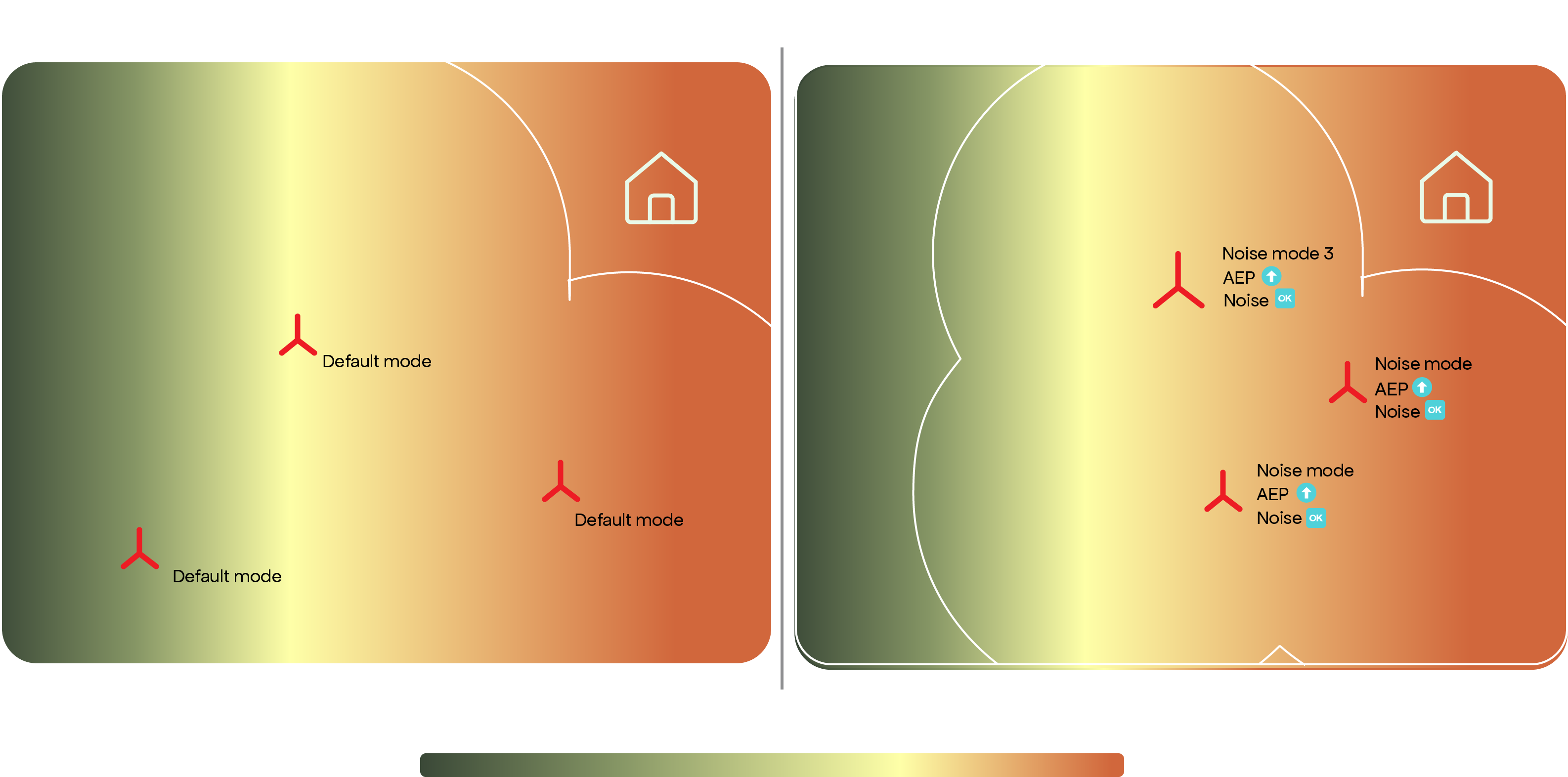
When only optimising the positions of wind turbines, it is typical to assume the turbines operate at the same power curve and emit the same noise profile. In real world projects, the operation modes are often fine-tuned to adhere to load or noise constraints on the site.
With windPRO 4.3 you can now optimise both the layout and the operation modes. This dramatically speeds up the time it takes to design a feasible curtailment scheme and can have a significant positive impact on the net present value (NPV).
Fill max with constraints
Maximise the number of turbines on a site while automatically respecting constraints such as setbacks, noise limits, and exclusion zones - all in a single optimisation step. The setup interface has also been redesigned for clarity.
Resource and WTG area map limits
View the spatial extent of resource data and WTG areas, helping you avoid setting up calculations outside valid data boundaries.
Realise non-optimal solutions
You can now select and realize intermediate solutions from the optimisation process, not just the final result.
Load curtailment optimisation (backend)
New backend support for optimising curtailment strategies to meet grid load constraints while minimising energy loss. This lays the groundwork for upcoming curtailment optimisation capabilities.
Noise solidarity model
Allocate noise budgets across turbines during optimisation, enabling fairer noise-limit compliance when multiple stakeholders share the same noise-sensitive area.
Noise modelling
Faster noise calculations through parallelisation
DECIBEL noise calculations now run across multiple CPU cores, significantly reducing computation time.
Example: 30 turbines, 21 receptors, German codes + iso-line map
windPRO 4.2
windPRO 4.3
Ratio
Screening disabled (seconds)
19
5
26%
Screening enabled (minutes)
143
33
23%
How does this benefit your project?
Discover how the noise upgrade in windPRO 4.3 improves overall noise optimisation.
METEO
Automatic data-swap detection
windPRO can now automatically detect swapped measurement data channels. For example, when wind speed and direction sensors have been wired to the wrong logger inputs. This catches a common field instrumentation error that can otherwise go unnoticed and compromise your analysis.
PARK
Year-specific curtailment schedules
Define curtailment schedules that vary by year, enabling more realistic modelling of phased operational strategies and evolving grid requirements. Also available through the scripting API.
Wake-loss roses in PARK
Visualise directional wake losses per turbine directly in the PARK map report. Instantly identify which wind directions cause the most wake impact across your wind farm.
Time varying losses
Calculate losses for time varying PARK calculations using an expanded set of categories and methods. Apply losses that impact wakes, losses with stochastic nature like availability, losses dependent on years (like degradation) etc.