
Noise from solar PV parks
Noise from solar PV parks
windPRO can now calculate external noise from solar parks. To make those calculations defensible, we needed source data that did not yet exist – so we commissioned SWECO, acoustician consultancy, to recommend generic noise data for different inverter sizes based on actual measurements.
Study
Independent acoustic measurement and data study
Carried out by
Sweco Danmark A/S for EMD International A/S
Founded by
The EMD Foundation
Sites
Greenlab, Høvsøre, Veddum Kær and Vemb (DK)
Measured
June-August 2024, 10:00-15:00 in full sun
Report
N6.075.26, version 1
Key result
Generalised sound power levels for three inverter power classes – 67.5, 85.0 and 93.8 dB LWA – with 1/3-octave spectra from 10 Hz to 20 kHz.
The situation
Solar parks are now being planned close enough to neighbours that external noise must be assessed alongside every other environmental impact.
windPRO can calculate the noise from a distributes source such as PV inverters. The input data was missing.
Wind turbines arrive with standardised, verified and warranted sound power data. Solar park components do not. When Sweco collected supplier information for planned parks, the quality varied widely: noise was sometimes given as a sound power level, more often as a level measured at an unstated distance, with no measurement set-up, no microphone position and no note of nearby reflecting surfaces.
Frequency distributions in 1/3- or 1/1-octave bands were rarely included at all, and it was often unclear whether a figure was A-weighted, a maximum or an expected value.
Sweco assessed the standard uncertainty on datasheet values used in this study at 5 dB — against 2–3 dB for their own measurements. For a screening calculation, that difference decides whether a layout looks feasible.
What was measured, and how
Sweco measured at four existing Danish solar parks in June, July and August 2024, each between 10:00 and 15:00 under clear sky, to catch the noise at maximum production. Source strengths were determined in accordance with the Danish EPA's Guideline no. 5, 1993, Beregning af ekstern støj fra virksomheder, as A-weighted 1/3-octave sound power spectra from 10 Hz to 20 kHz. The aim was at least three inverters of each type per park, so that a mean and a spread could be established rather than a single reading.
Measurements were combined with supplier datasheet values, weighted equally, and grouped by unit capacity. Uncertainties follow Orientation no. 36 from the Danish EPA's reference laboratory: 2 dB where conditions were good, 3 dB where they were less favourable — for instance where an inverter sat close to a reflecting panel surface, or where a tracker measurement was affected by background noise.
Two supplementary studies ran alongside: week-long monitoring of how the noise varies over the day, and a loudspeaker experiment on how the panels themselves affect sound propagation.
What actually makes the noise
Across every park, inverters and combined inverter–transformer units were the dominant sources. The noise is cooling noise: fans running harder as conversion losses turn into heat, so emission rises with the unit's power rating. It is broadband, typically peaking between 500 and 800 Hz. Trackers proved not to be a significant source. They move in bursts of 5–10 seconds as the panels follow the sun, at markedly lower source strengths than inverters, and they do not idle. Battery storage (BESS) was outside the scope of this study.
The generalised data
Inverter source strength tracks capacity closely enough to group. Three power classes were established, each with an overall A-weighted sound power level and a normalised 1/3-octave and 1/1-octave spectrum.
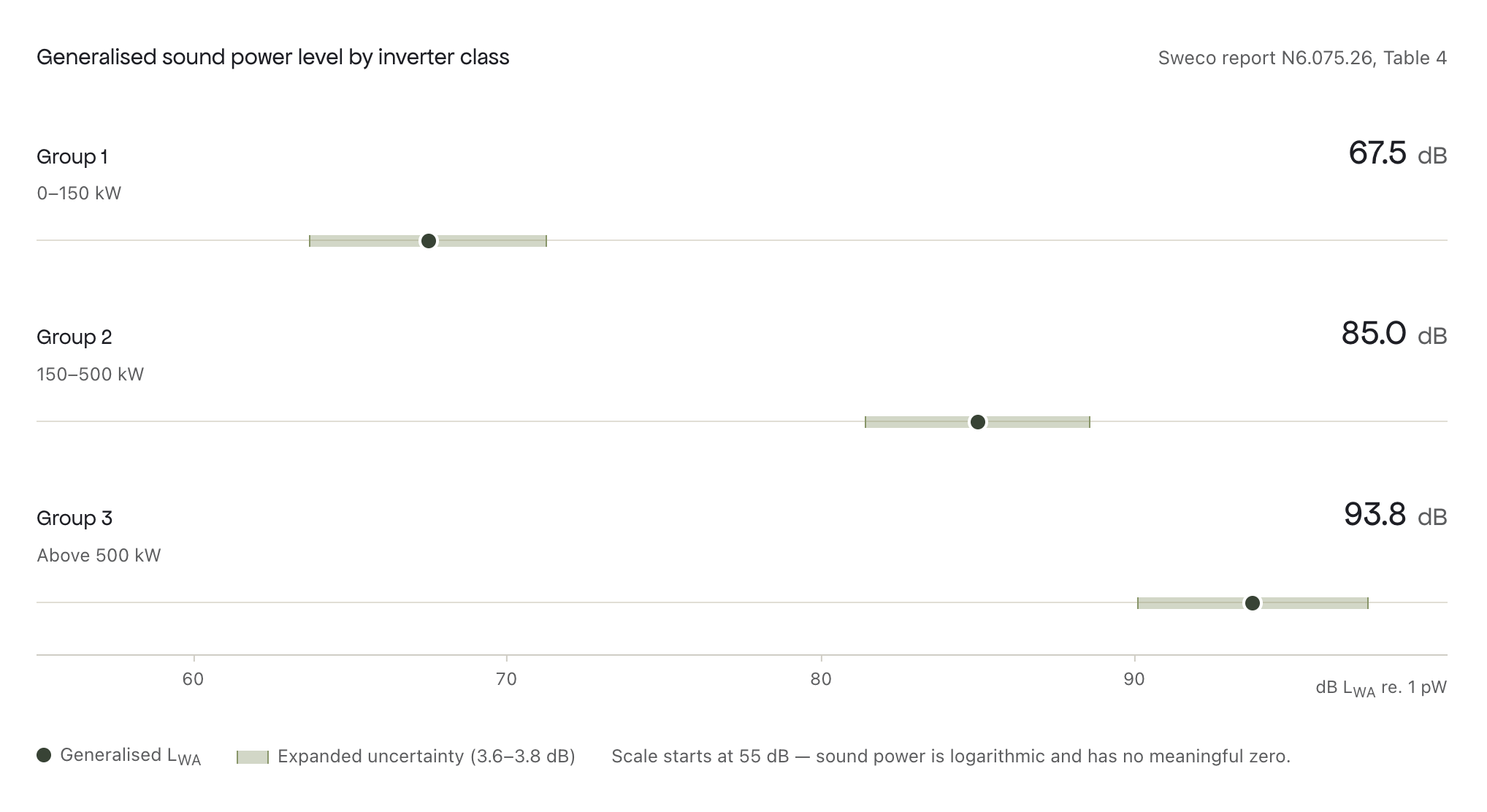
The step between classes is real and large: a group 3 unit is some 26 dB above a group 1 unit. The spectra shift too — larger units put proportionally more energy into the low and mid bands, which travel further and are harder to screen.
Variation remains within each group. In the 0–150 kW class, the quietest inverter type measured sat around 10 dB below the noisiest, and its emission was dominated by high-frequency content above 10 kHz that attenuates quickly with distance. The generalised spectrum for that group was therefore taken from the noisiest type — conservative, but realistic for a calculation that has to stand up.
Night is quieter – but not as quiet as it looks
Because a solar park only makes noise when it makes power, its emission follows the sun. Sweco monitored two parks continuously for a week – one at a cluster of five inverters, one at a combined inverter and medium-voltage transformer unit – and normalised the results against the highest level measured under full production.
The reductions are substantial: more than 30 dB at night and around 15 dB in the evening, compared with full daytime operation. But two things complicate the picture. The 30 dB figure is partly a floor set by background noise from a neighbouring wind farm and a nearby road – the true reduction may be greater. And the park wakes before the regulatory day does: production starts climbing in the early morning, while the stricter night limits still apply until 07:00. At some points in that window, the half-hour mean was only 10 dB below the daytime maximum.
Reccomendation
Where a night-period reduction is credited for inverters in a noise calculation, limit it to 10 dB for the period 22:00–07:00. The larger reductions seen at night do not hold through the early-morning hours. For evening periods, the inverters may still be in the process of cooling down and a reduction is not recommended.
Do the panels shield the noise?
Inverters in decentralised parks are often mounted directly on the panel rows, which raises an obvious question: do the panels screen the noise, or reflect it? Sweco tested it directly, replacing an inverter with an omnidirectional loudspeaker playing broadband noise beneath a panel tilted at 35°, then measuring at 0°, 45°, 90°, 135° and 180°, five metres up and eight metres out.
Both screening and reflective effects are present, and they depend on direction. On the source side of the panel (0° and 45°) the noise was amplified by 3–5 dB across 500–5,000 Hz — the same band where group 1 and group 2 inverters emit most. Behind the panel (90° to 180°) the noise was attenuated. Nord2000 calculations in SoundPlan 9.0 reproduced the measured differences well, and a roughly 3 dB increase is what reflection off a hard, flat surface close to a source would predict.
Whether that nets out as a gain or a loss depends on the layout. Fixed rows tilted alternately east and west, meeting at the top like a saddle roof, act as an effective screen. Single rows, or trackers whose angle changes through the day, can do either. For a generic PV farm it is recommended not to factor in screening and reflection from the panels, while with an actual panel design some screening attenuation is likely.
Reccomendation
Do not apply a general correction for panel influence. Assess it per project, from the actual panel arrangement and the placement of the inverters relative to it. No correction tends to be a conservative choice.
Using this in windPRO
Use the generalised values for screening and planning, where project-specific supplier data is not yet available. That is what they were built for.
Carry the expanded uncertainty through. Either add it to the stated LWA, or present it alongside the calculated result. windPRO can pick it up from the dataset.
Replace them as the project matures. Generalised data does not substitute for a project-specific noise assessment based on the actual equipment.
No generalised values exist for standalone transformers or trackers. The data basis was too thin – transformers are frequently integrated into inverter units, and trackers were deliberately deprioritised.
Key takeaways
1
Inverters and combined inverter–transformer units are the dimensioning noise sources in a solar park. Trackers are not.
4
Panels both reflect and screen depending on geometry. No general correction — assess it per project.
2
Three inverter power classes now have generalised source strengths and spectra: 0-150 kW. 150-500 kW and >500 kW.
3
Night-time emission drops sharply, but credit no more than 10 dB of reduction between 22:00 and 07:00.
Read the full report
Sweco Danmark A/S · Report N6.075.26 · Version 1 · 27 pages · PDF
Download Støj fra solcelleparker report
Where this is used
windPRO module
DECIBEL
Calculates external noise and verifies it against the limits that apply at each neighbour — now for solar park components as well as turbines.
Manual · Chapter 14
Solar PV
How DECIBEL handles source data, propagation models, receptors and noise limits, step by step.
windPRO module
SOLAR PV
Lays out panels, combines wind and solar in one project and calculates annual production including shadow losses.
Manual · Chapter 6
Environment
How DECIBEL handles source data, propagation models, receptors and noise limits, step by step.