
Case Study 1: Constrained Layout, 20-Year Lifetime
How smart curtailment turned a marginal project into a net energy winner
Pre-construction
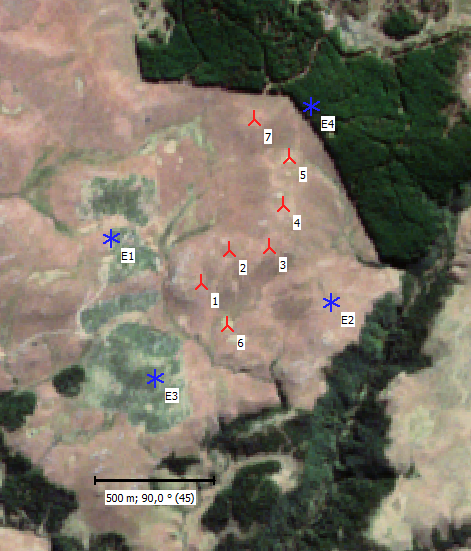
The situation
A developer wanted to place seven new turbines along a height contour - a logical layout given the terrain, but one that left little room for manoeuvre. The site was already home to four existing turbines, and the available land was tightly constrained by environmental regulations.
On paper, the layout looked feasible. In practice, the close spacing and wake interactions between new and existing turbines created a fatigue problem: without intervention, several turbines would not reach their intended 20-year lifetime.
The question was not just whether the project could be built - but whether it could be built in a way that was economically viable and certifiable.
The challenge
Fatigue lifetime in a dense layout is determined not just by wind speed, but by wake-induced turbulence from neighbouring turbines. When turbines operate in each other's wake, the additional loading accelerates wear - and in a constrained site, there is limited room to reposition turbines to reduce that effect.
The conventional response is blanket curtailment: shut turbines down in certain wind conditions to limit exposure. But blanket curtailment is blunt. Applied without optimisation, it reduces annual energy production (AEP) significantly — and may still fail to protect all turbines equally.
The team needed a smarter approach: curtailment rules that were precisely calibrated to each turbine's fatigue exposure, minimising energy loss while ensuring every turbine reached 20 years.
The approach
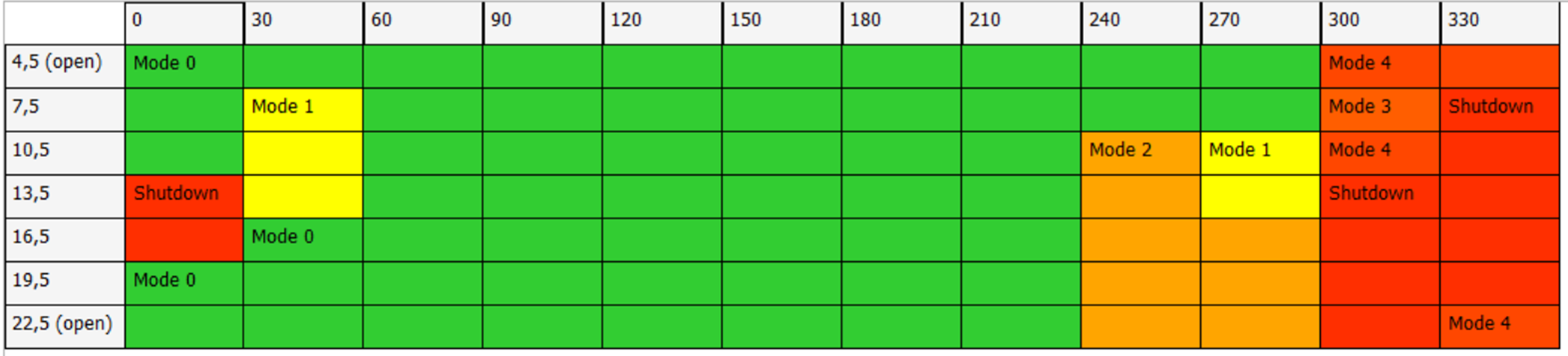
Using windPRO's Lifetime Optimizer, the team modelled fatigue loads across the full operating envelope - wind speed and direction binned across 12 intervals each - for all 11 turbines simultaneously, accounting for wake interactions between them.
The optimisation used standard IEC settings. Both new and existing turbines shared the same configuration (design class IIB, 20-year target lifetime) and the same sensor inputs: blade root bending moments on both axes, with four load modes per turbine plus shutdown.
The Optimizer then calculated the curtailment scheme that would protect each turbine's fatigue lifetime while keeping cumulative AEP loss as low as possible.
The results
6.9–10.4%
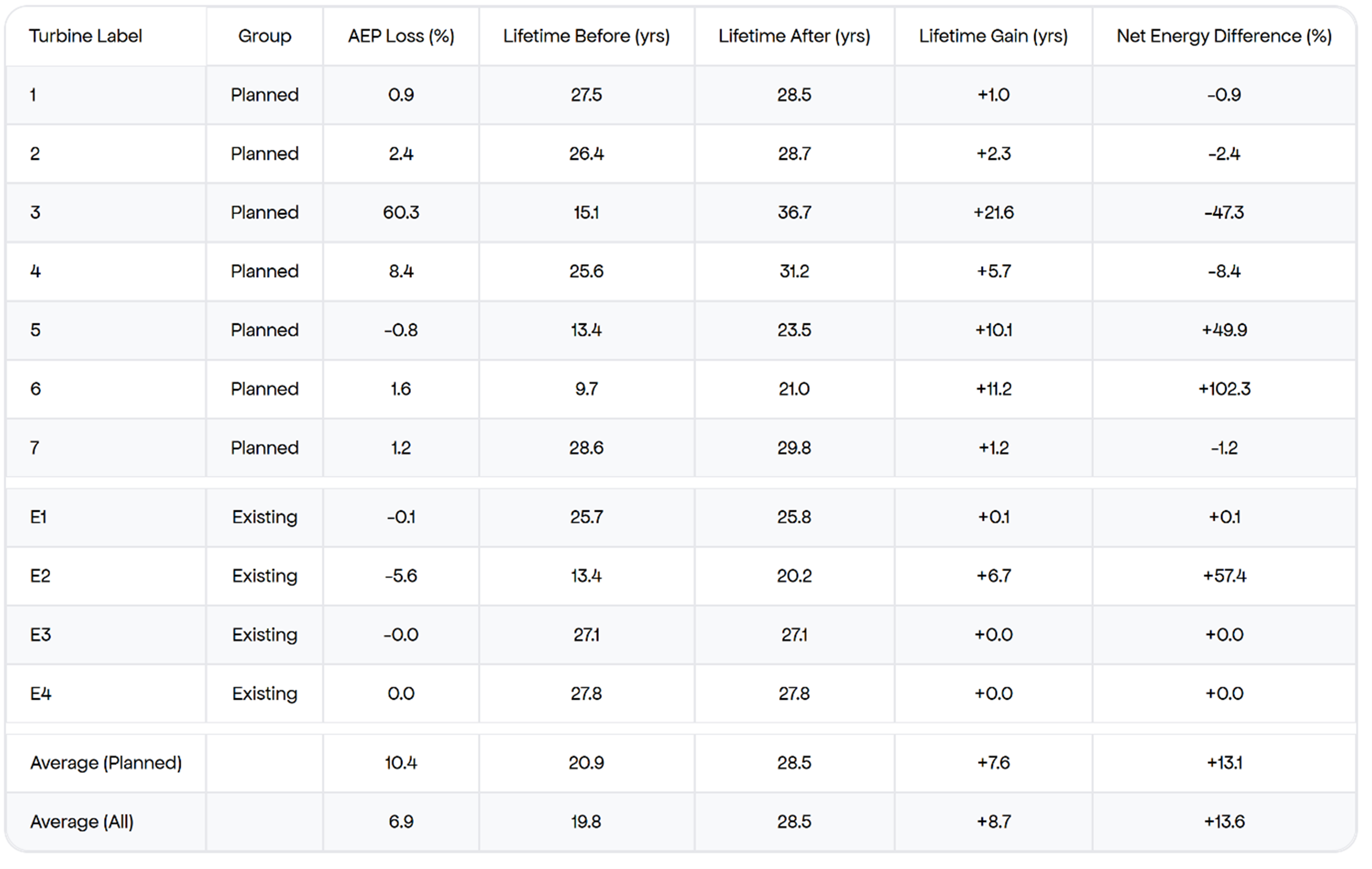
Annual production loss across new turbines under the optimised curtailment scheme. Turbine 3 was most affected at 60% annual AEP reduction due to its exposed position.
28.5 years
Combined fatigue lifetime shortfall across 4 turbines (T3, T5, T6, E2) if no curtailment is applied — representing years of zero energy production.
+13.6%
Average net energy gain across new turbines over the full 20-year lifetime, compared to the unoptimised baseline. By ensuring turbines reach their full lifespan, the curtailment strategy that appeared to reduce output was actually protecting it.
The key insight
Focusing only on annual AEP loss from curtailment is misleading. The Lifetime Optimizer revealed that the right metric is total energy produced over the asset's life - and on that measure, the constrained layout with optimised curtailment outperformed the uncurtailed alternative by 13.6%.
Without curtailment, four turbines faced a combined fatigue shortfall of 28.5 years -meaning years of zero energy production. In the most severe scenario, the layout would have failed certification entirely, producing nothing at all.
The extended lifetimes are based on fatigue calculations per IEC standards. In practice, other factors such as blade erosion will also influence operational lifetime, but the analysis demonstrates clearly that optimised curtailment changes the fundamental economics of a constrained site.
What this means for the decision
This case illustrates one of the most common misreadings in wind project economics: treating annual AEP loss from curtailment as a straightforward negative. The Lifetime Optimizer reframes the question - the relevant metric is not how much energy do we lose this year but how much total energy do we produce over the asset's life.
For a developer evaluating a constrained site, this shifts the calculus significantly. A layout that looks marginal under annual AEP analysis may be strongly viable under a lifetime energy analysis - provided the curtailment scheme is optimised rather than assumed.
Key takeaways
Annual AEP loss from curtailment (6.9–10.4%) significantly understates the true picture.
Without optimised curtailment, four turbines faced a combined 28.5-year fatigue shortfall.
The Lifetime Optimizer delivered a net +13.6% energy gain over the full 20-year lifetime.
A layout that would likely have been rejected or under-certified was made viable
Next case study
Case Study 2: Existing turbines with limited life left - can new turbines still be approved?
A neighbour park with low design class turbines and only 7 years of fatigue life left. How windPRO found a solution - and simplified it to 15 curtailment rules.
The modules you need
Your windPRO Training Hub
Dive into our comprehensive courses, webinars, and tutorials to master windPRO’s powerful features. Whether you’re a beginner or looking to refine your skills, our resources will help you unlock the full potential of your wind projects. Start learning today!
Courses relevant for this use case
- Introduction to windPRO
- Advanced Wind Resource Assessment